NOCs invited to update Sustainability Dashboard data as ANOC hosts second sustainability webinar
ANOC is continuing its efforts to promote sustainability awareness and foster exchange among NOCs by inviting them to contribute to the development of the NOC Sustainability Dashboard and through the hosting of the second ANOC Sustainability Accelerator Programme (SAP) Webinar.
The Webinar was dedicated to data collection among NOCs, which aids them in measuring and subsequently reducing their carbon footprints.
NOCs invited to update Sustainability Dashboard data
Following the success of the NOC Social Media Dashboard, ANOC has launched the first draft of the NOC Sustainability Dashboard, developed in collaboration with the IOC and supported by the ANOC Sustainability Commission. The Dashboard aims to provide a comprehensive picture of the NOC community’s sustainability progress and to serve as a platform for sharing best practices and celebrating collective achievements.
NOCs are encouraged to fill out or update their data by 21 November 2025 via the questionnaire which was sent out individually to each NOC’s official email address on 21 October 2025. The information collected will help produce the first official version of the Dashboard, which will be made publicly available on the ANOC website in January 2026, ensuring that it accurately reflects NOC’s ongoing efforts to advance sustainability.
The shared version of the Dashboard includes preliminary data from the end of 2024 and remains confidential at this stage, with NOCs asked to provide feedback on it. For any technical assistance or questions, NOCs may contact info@anocolympic.org or andres.santi@anocolympic.org.
ANOC SAP Webinar 2 focuses on measuring carbon footprints
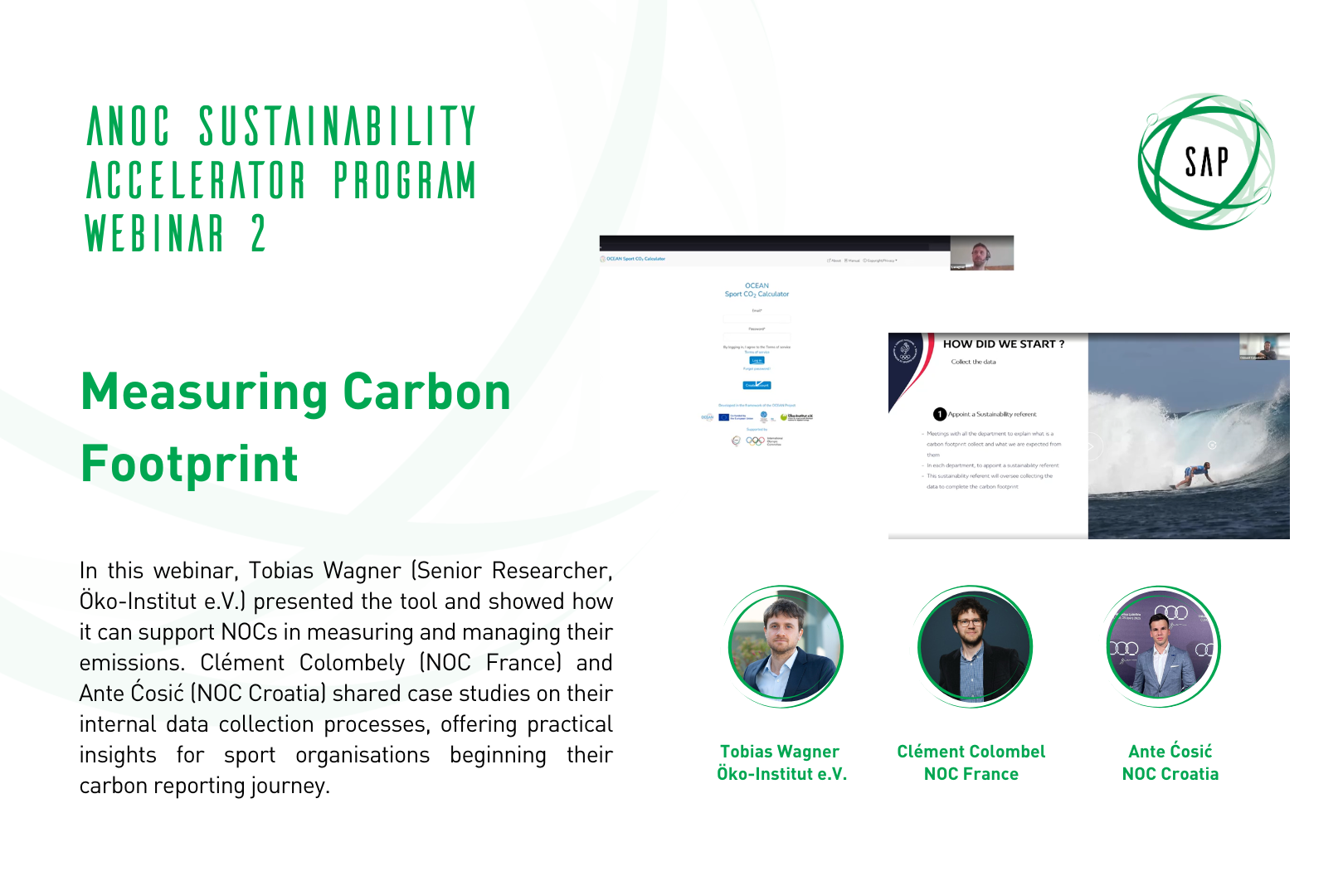
On 9 October 2025, the second SAP Webinar brought together 45 participants from NOCs across all continents to explore practical approaches to measuring carbon footprints within their organisations.
The session featured insights from Ante Kosic (Croatian NOC), Clément Colombel (French NOC), and Tobias Wagner (Öko Institute), and underscored the importance of having robust data collection within NOC departments. Kosic highlighted the challenges of data organisation in sustainability projects, emphasising the need for a structured approach and leadership support. Colombel shared the French NOC’s experience and recommended appointing a sustainability referent in each department to improve data accuracy and communication.
In addition, the webinar introduced and presented the functionalities of the SportCo2 Calculator, which was designed to assist organizations in tracking and reducing their emissions. The tool was co-developed by the Öko Institute, and the European Olympic Committees (EOC) EU Office, and supported by the IOC and ANOC, to make this European tool available worldwide in three different languages—English, French, and Spanish. The NOC community is encouraged to use this tool to measure their carbon footprint. If NOCs are wish to translate the tool into their national languages to make it available to their National Federations, they are welcome to contact Eva Rebmann (rebmann@euoffice.eurolympic.org).
Concluding the session, Rebman from the EOC EU Office presented available resources to support organisations in their sustainability efforts, including a Climate Action Officers Guide and a toolbox of carbon reduction measures:
The full recording of the ANOC Sustainability Accelerator Webinar 2 – Measuring Carbon Footprint is available on ANOC.tv.